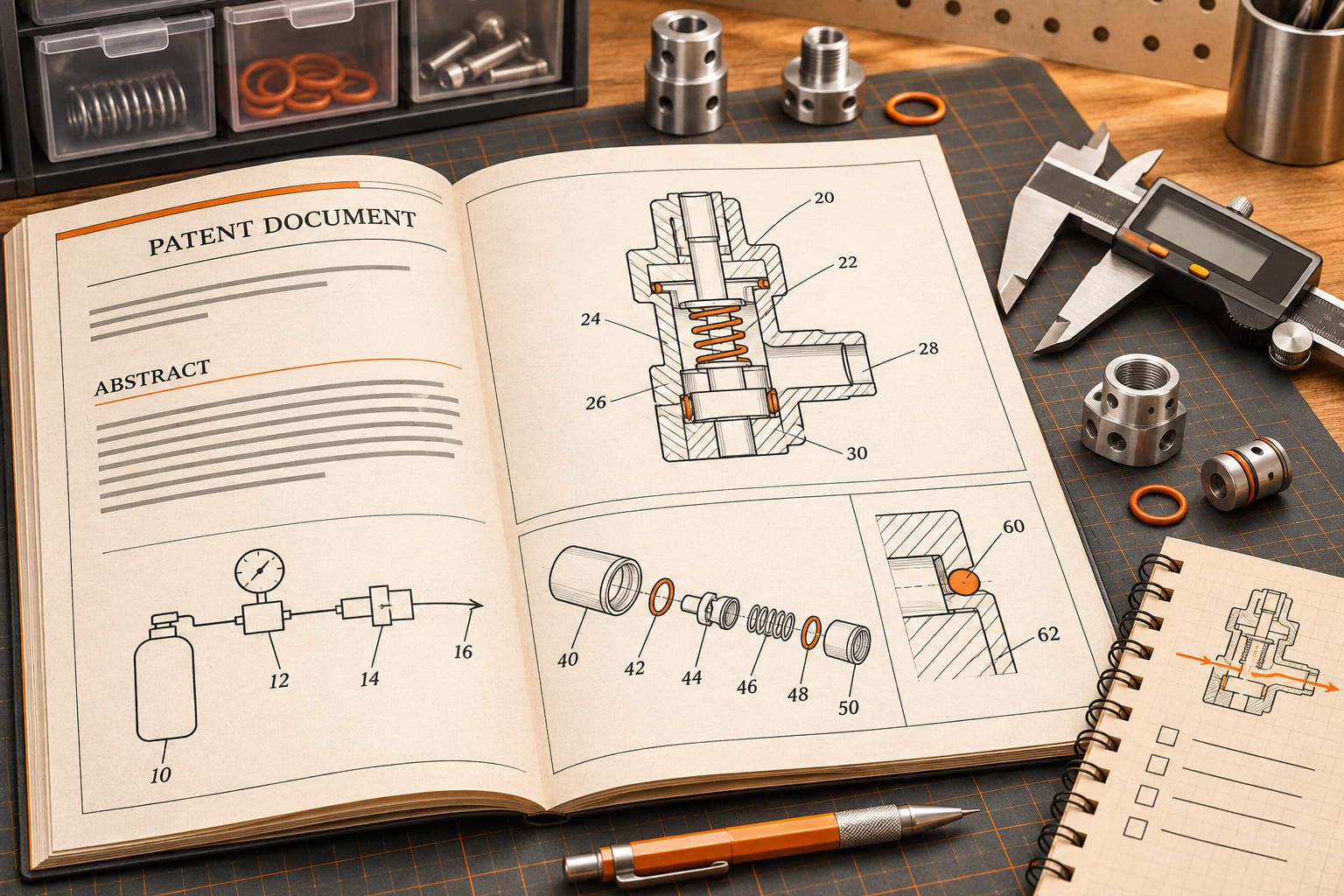
What an HPA Nozzle Patent Actually Protects
There is a classic failure in HPA builds that every builder knows even without naming it: the BB stalls halfway between magazine and chamber, air arrives late or escapes sideways, and the shot comes out weak, doubled, or not at all. That family of problems — nozzle sealing, timing and compression — is precisely what the industry tried to solve with patents. Analyzing one of them carefully helps you understand why your build demands millimeter precision.
This article explains the mechanical principle described in US 10,401,121 B2, “Pneumatic Projectile Launching System” by Polarstar Engineering & Machine LLC (inventors Stephen J. Hague, Tanke Hall Hewat and Jutras; granted September 3, 2019, a continuation of a line that began in 2012). And it makes clear what it does NOT claim: none of our kits incorporates the invention claimed in that patent.
The problem described in the patent
In this kind of pneumatic engine, the nozzle pushes the BB into the hop-up bucking while simultaneously sealing the air. Two conflicting functions: to load, the duct must be open and clear; to fire, it must close hermetically against the BB. Any misalignment, play or wrong length turns that instant into a lottery — BBs biting each other (double feed), air leaking sideways, compression that varies shot to shot.
The claimed solution, in plain words
The published abstract describes a body defining a continuous bore with a nozzle positioned near its forward end, movable between two positions: rearward, it facilitates projectile passage through the port; forward, it blocks that port and prevents passage. In other words, the nozzle itself acts as a gate separating the loading phase from the firing phase inside one continuous duct.
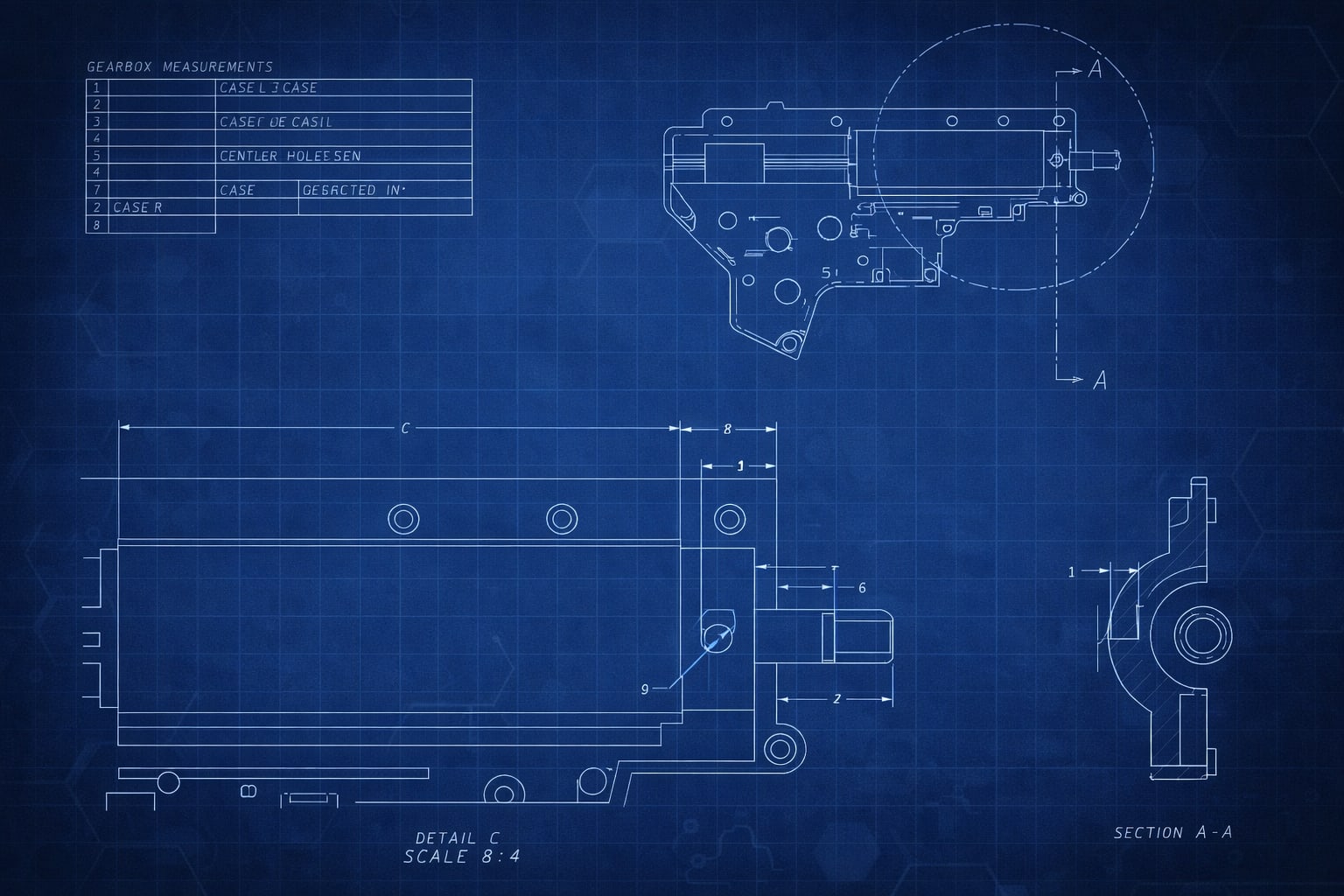
What matters to a maker is not the legal abstraction but the physical consequence: anyone designing around that concept needs very tight coaxiality tolerances. If the nozzle axis and chamber axis do not coincide, the movement between positions rubs, fails to seal, or drags the BB. The patent protects one concrete way of solving the seal; the rest of us solve the same problem from the other end — by guaranteeing alignment.
What we observe (and what we do not)
The lab’s own observations, verified in our installs, unrelated to any claim:
- When the nozzle sits off-center relative to the chamber front plane, the BB bears asymmetrically on the bucking: hop varies by side and the typical “midcap syndrome” appears on mid-capacity magazines.
- A wrong nozzle length forces the assembly outside the range it was designed for: too long and the BB never seats; too short and air arrives early.
- The most reliable fix is not compensating with harder buckings or swapping them constantly, but referencing the whole assembly to a fixed point of the chassis.
These are empirical workshop observations, not a legal reading of the patent. For exact lengths and tables, see our Polarstar F2 nozzle guide.
Where this fits the lab’s kit
The PolarStar F2 + MAXX Model alignment kit v2.1 (EUR 23) addresses the problem from the lower’s geometry, not from the engine: it uses the body’s rear pin as the fixed reference, mounts the base with M3 inserts and locks the chamber with a top cap specific to MAXX Model. Nothing in the engine is modified — the kit simply ensures the nozzle faces the chamber concentrically and at the correct distance so sealing and loading work within their design range. Required separately: 4× M3×4.2 inserts and 4× M3×8 SHCS screws.
If you run a GATE Pulsar D2 instead of an F2, the equivalent Pulsar D2 + MAXX Model kit applies the same centering logic with an adapted cap.
Important note
That a patent publishes a principle does not mean our kit practices the invention, nor that Polarstar endorses this project. The patent here is a source to contextualize a shared engineering problem. Before marketing any product as implementing a live claim, professional review is required; we make no such statement.
Conclusion
Understanding what a patent protects gives you two things: respect for the system’s tolerances and better buying judgment. Nozzle-BB sealing is delicate by design; the difference between a consistent build and a erratic one is usually how rigidly you reference your chamber. If you are building an F2 with MAXX, start with the kit page and its install guide; if versions confuse you, the MAXX compatibility table closes the loop.