How to Read an HPA Patent: A Practical Guide for Makers
When someone shares a PDF of an airsoft HPA patent, most people open the abstract, skim two paragraphs and close it. Fair enough: these documents are written in a legal language nobody teaches you. And yet they are one of the best free technical sources that exist: every patent describes a real problem, explains the chosen solution and, most valuably, shows exactly what its owner wants to monopolize.
This guide teaches you to read an HPA patent in about twenty minutes, with concrete steps and public documents as examples. It is not legal advice: it is technical literacy.
What a patent is (and is not)
A patent is a deal: the inventor publishes the invention in detail and, in exchange, gets the right to exclude others from exploiting it for a limited time and only in the territory where it was granted. Three practical consequences:
- Published is not granted. A published application (“A1” documents) may never become a patent, or may be granted with a much narrower scope than requested.
- Granted is not universal. A US patent is valid in the United States. In Europe or Poland you need an equivalent family member, and it may not exist.
- In force is not forever. The term is usually twenty years from filing; many older HPA patents have already expired or are close.
Never infer status from the PDF filename. Check the official register.
The blocks of a document
All publications follow the same structure, marked with INID codes in parentheses:
| Field | What to look for |
|---|---|
| Publication number | Office + number format (US 10,401,121 B2; EP 4 696 975 A1; PL 449544 A1) |
| (45)/(43) Date | Grant or publication date: distinguish A1 (application) from B2 (granted) |
| (71)/(73) Applicant/Owner | Who controls the right |
| (72) Inventor | Who created the invention |
| (51)/(52) IPC/CPC classification | The “technical tag”: F41B 11/xx is the compressed-air gun and projectile-toy family |
| (22) Filing date | Starting point of the twenty-year term |
| (57) Abstract | A general idea, never the real scope |
| Drawings | Numbered figures; the key to understanding the geometry |
| Claims | At the end: they define what is protected. This is the part that matters |
Step by step
1. Identify the document type
The kind code says it all. In the US, “A1” is a published application and “B2” is a granted patent. A real example from this folder: US 2025/0027745 A1 is the published Kythera system application, and US 12,460,899 B2 is the same family already granted to Polarstar Engineering & Machine (inventors Benjamin Noji and Rodd Rambo, patented November 4, 2025). They started as the first and became the second: which one you cite changes the legal status.
2. Use classification to find complete families
CPC class F41B 11/723 groups pneumatic projectile launching systems. Searching that class on Espacenet reveals that one invention is often filed in several offices. For instance, GATE Enterprise (Krakow, Poland) published its pneumatic firing assembly as PL 449544 A1 on February 23, 2026, with priority dating back to November 2023: equivalent European or national filings may sit behind it.
3. Start with the drawings, not the text
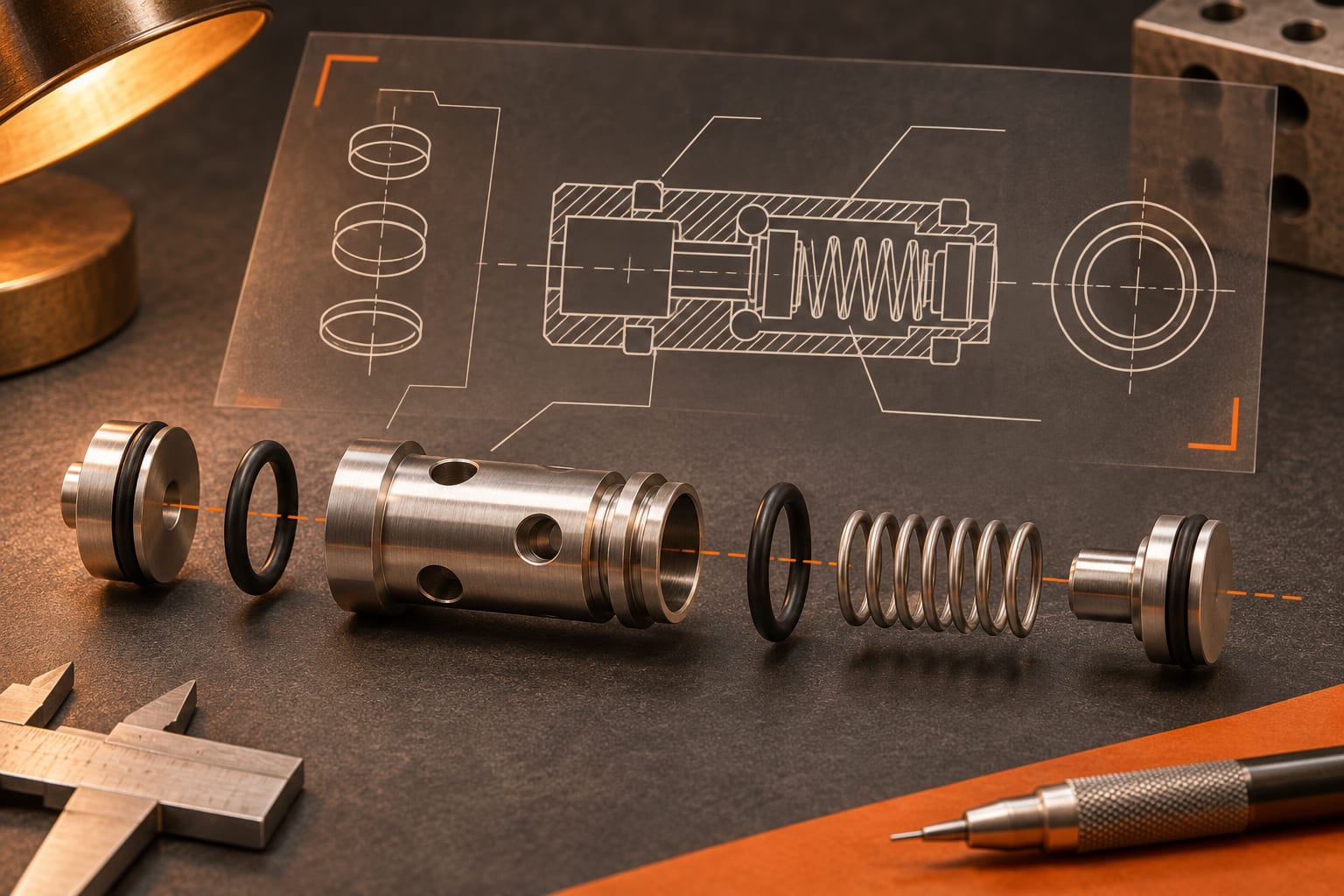
Drawings are universal; legal text is opaque. Take the figure showing the longitudinal section of the engine and locate three things: where air enters, which part moves first, and where the flow ends. Then find the reference numerals (the numbers with arrows) in the text: each one names a component in the description.
4. Read the Background column looking for the complaint
The whole technical problem hides in one sentence: “the prior art suffers from…”. In US 10,401,121 B2 (Polarstar Pulsar) the complaint is that earlier motors use a nozzle that must retract to let the BB pass and advance to seal against it, with tolerances that cause leaks and inconsistent feeding. Their claimed solution: a movable nozzle inside a continuous bore that, in the rearward position, allows projectile passage and, in the forward position, blocks the projectile port.
5. Go straight to claim 1
It is the broadest: if your case does not fall under claim 1, it almost certainly falls under none. Read it as a checklist: every “comprising” or “wherein” adds a mandatory component or behavior. An invention is only enforced against something that meets all those conditions at once. Dependent claims (2, 3, 4…) add details and narrow the scope.
6. Verify status and territory in the official register
For US patents use Patent Public Search and especially the maintenance-fee record: a granted patent that skipped annuities can lapse before twenty years. For European and Polish documents, Espacenet’s INPADOC tab gives status per country. Never keep the PDF as your only source.
Common mistakes when citing patents
- Confusing the abstract with protection. The abstract is courtesy; claims set the scope.
- Attributing endorsement. That the owner is Polarstar does not mean it approves any third-party accessory.
- Ignoring continuations. An owner can keep expanding the family for years; free today, blocked tomorrow.
- Assuming “educational use” is a license. Learning from a patent grants no commercial rights.
How this relates to the lab’s kits
Patents describe engines and their internal mechanisms. Our hop-up alignment kits do not reproduce any of those inventions: they are 3D-printed parts that center the hop-up chamber relative to the nozzle using the lower’s rear pin as reference. To understand the full chain of why centering matters, cross-read our Polarstar F2 nozzle length guide and the MAXX Model compatibility series. For building, the full catalog is in HPA Kits.
Quick FAQ
Where can I read patents for free?
USPTO Patent Public Search (US), EPO Espacenet (worldwide) and UPO (Poland) offer free access to texts and images.
Is a 2014 patent still in force?
It depends. Maximum term is twenty years from filing (US 8,671,928 B2, filed 2012, runs to roughly 2032 if fees were maintained). Always check current status in the register.
Can I copy a figure for my blog?
Not without a legal basis. You may explain the mechanism in your own words and draw original schematic diagrams based on your understanding; that does not reproduce the document.
Conclusion
Reading patents is a skill, not a gift: document type, classification, drawings, background complaint and claim 1. In that order, any maker can get far more out of the PDFs circulating on Discord and Reddit. And when you want to move from theory to build, the kit store has installation and compatibility guidance for every configuration.